
The month of Ramadan is that in which was revealed the
Quran; a guidance for mankind, and clear proofs of the guidance, and the
criterion (of right and wrong). And whosoever of you is present, let him fast
the month, and whosoever of you is sick or on a journey, a number of other days.
Allah desires for you ease; He desires not hardship for you; and that you should
complete the period, and that you should magnify Allah for having guided you,
and that perhaps you may be thankful.
Why
is the ninth month of the Islamic calendar – ramaḍān – so important for Muslims? It is saint because
it is the month of the first revelation of the Quran to Muhammad. During ramadan
Muslims must fast from dawn till sunset, which means they mustn’t eat any kind
of food, drink beverages (including alcohol) and engage in sexual relations.
Exceptions are for those who: are elderly, pregnant, breastfeeding,
menstruating, chronically ill, suffer from an illness or travel. Ramadan
is fardh (obligatory) for Muslims and in 2017 it started on
26th May and finished on 24th June.
After
a month of fasting, Muslims are celebrating Id al-Fitr meaning
“feast of breaking of the fast” is also called Sweet Festival. In
Germany Id al-Fitr celebration is called Ramadanfest, which
was officially accepted by KRM – Koordinationsrat der Muslime in
Deutschland. This important religious holiday marks the end of Ramadan and
lasts for three days (this year from 25th till 27th of June). Depending on a
country there a different dishes served during Id al-Fitr, yet all
of them are sweet. For instance; Baklava in
Turkey, Ketupat in
Indonesia; Sheer
Khurma in
India; Malaysia, Brunei, Bangladesh, Pakistan, Iran; and in South Asia
– Cham
Cham, Barfi, Gulab
Jamun and Ras
Malai. So how does the celebration of Id
al-Fitr look like? There are some general rituals which every Muslim
should follow:
-
- Wake up early (before the sunrise), clean your
teeth with a toothbrush, have a shower before Salatul
Fajr (the pre-sunrise prayer), put on new clothes or the best ones
you have and apply perfume.
- Wake up early (before the sunrise), clean your
-
- Have a small sweet breakfast – preferably dates
(kind of fruit) – before going on foot to have salaat (Eid
prayer). Don’t forget about Zakat-ul-fitr – an (obligatory)
act of charity, give some money to the poor and the needy perfomed shortly
before salaat.
- Have a small sweet breakfast – preferably dates
-
- Choose different routes to and from the prayer
area.
- Choose different routes to and from the prayer
-
- Do not fast.
-
- Greet other Muslims with ‘Eid
Mubārak (Blessed Eid) or ‘Eid Sa‘īd (Happy
Eid).
- Greet other Muslims with ‘Eid
-
- Show happiness, forgive and forget the anger and
quarrels.
- Show happiness, forgive and forget the anger and
Photos
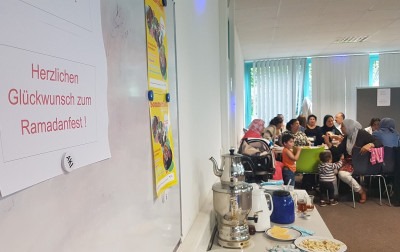
which can be seen below were taken during Ramadanfest which took place on 29th
June 2017 in Münster, Germany. The event was organized by AKI
e.V. (Arbeitskreis International e.V.) which
is a non-profit and independent organization with a purpose of reducing
barriers and improving the coexistence between people of different origins.
They support mutual understanding and offer help to migrants to improve their
situation. They are also a part of a citywide network Integration für
Menschen mit Migrationsgeschichte (Integration
for People with Migration History).
The event itself was combined with Frauenfrühstücke (breakfast
for women) which takes place once a month on Thursdays. Tasty food, amazing
Turkish Tea and live band. One of the participants of Ramadanfest, Seval Kocaman
from Bürgerhaus
Bennohaus, answered why she attended the celebration organised
by AKI e.V.:
“After four weeks of fasting we want to spend time
together – to talk, to dance, to celebrate”. Having good time together,
supporting each other, respecting and interacting with people of the same
religion who live in Münster.”
Happy ending of ramadan brings the mercy of Allah. It
teaches a Muslim to have distance to desires and focus entirely on the Lord and
his blessings. What’s more, the celebrations are aimed to create a stronger bond
between the Muslims and their Lord Allah.
Beata Jaranowska